
Deep links
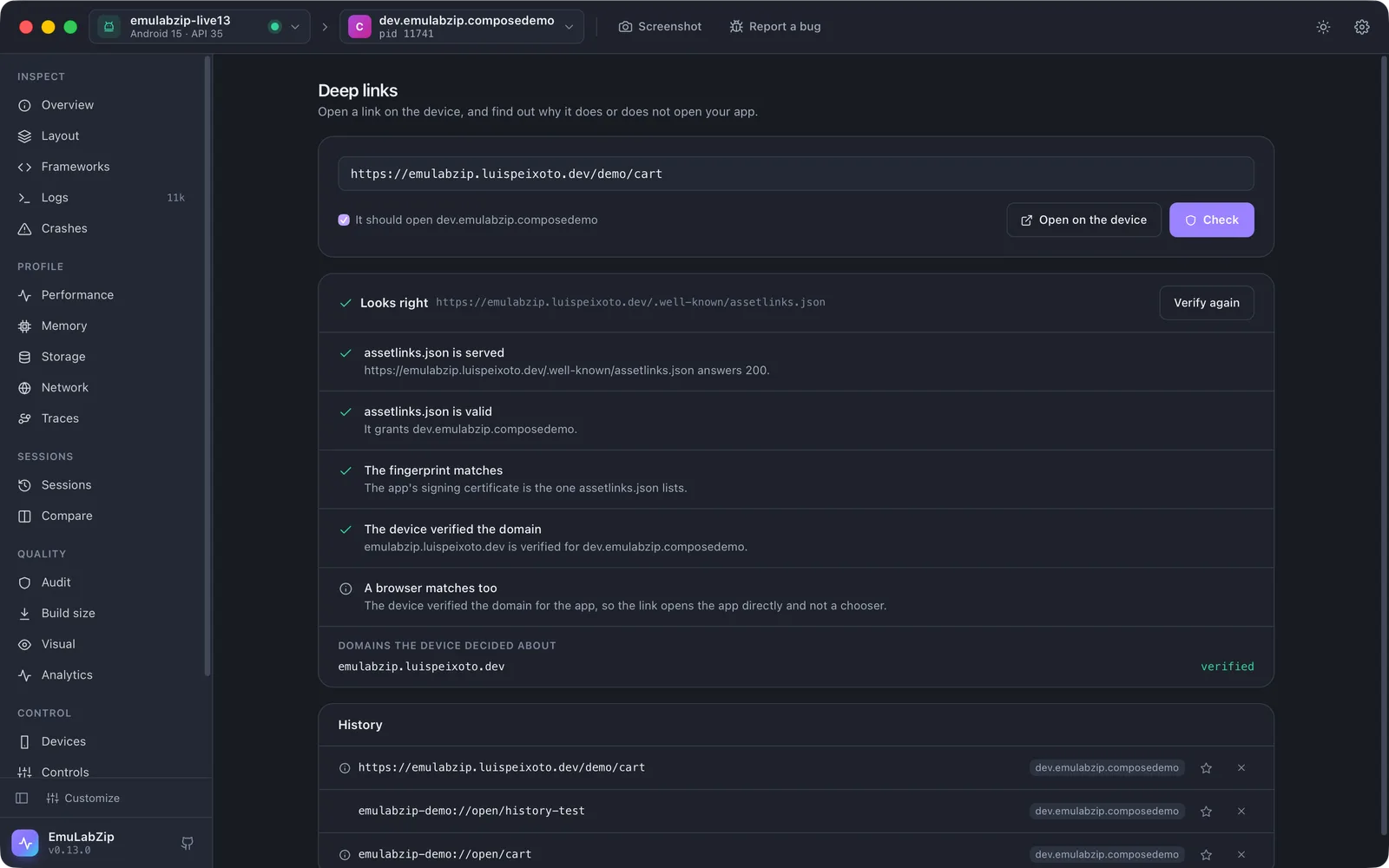
A web link opens an app, instead of the browser, only when two things agree: the domain says the app may (a file on its website), and the app claims the domain. When one side is wrong, the link opens the browser and nothing says why. Deep links opens a link on the device and checks both sides.
In the app#
Open Deep links in the sidebar, type a link, and:
- Open on the device opens it, and remembers it;
- Check reads the domain's file, asks the device what it decided, and lists what is right (✓), what to look at (!) and what is wrong (✗), each with what to do about it.
The history keeps the last 100 links with the result of their last check, and pins the ones you use often.
On the command line#
emulabzip link open "myapp://open/cart" --app com.example.shop
emulabzip link check "https://shop.example.com/cart/3" --app com.example.shop        # exits with an error when something is wrong
emulabzip link verify com.example.shop       # asks Android to verify the app's domains again
emulabzip link history
link check --json prints the findings, for CI. MCP has check_link.
What is checked#
On Android
https://<domain>/.well-known/assetlinks.jsonis served with status 200, without a redirect (Android does not follow them), asapplication/json, and is valid;- it grants the app: its package name is in a statement with
delegate_permission/common.handle_all_urls; - the app's signing certificate matches: the SHA-256 the device reports (
pm get-app-links, Android 12 and later) is one the file lists. A debug build is signed with the debug key, not the release key; - the device verified the domain for the app, and the user's "Open supported links" switch is on; when it is not, the fix
is
pm verify-app-links --re-verify <app>, which Verify again andlink verifyrun; - who opens the link (
cmd package resolve-activity): your app, another app, or nobody. A chooser that lists a browser is not reported when the domain is verified, because a verified link goes straight to the app.
On iOS
https://<domain>/.well-known/apple-app-site-associationis served with 200, without a redirect, and is valid (applinkswithcomponents, or the olderpaths);- the app's bundle id is in
appIDs, and a rule matches the link's path: the first matching component decides, and anexcluderule can turn it away; - the app's Associated Domains entitlement has
applinks:<domain>, and its team id is the file's (read from the app's signature on the simulator; an unsigned build has none, and that is said).
For a link of the app's own scheme (myapp://…) there is no domain file; the check says who opens it.
Limits#
- A simulator does not verify domains the way a device does, so the iOS check is about the files and the entitlement.
pm get-app-linksneeds Android 12 or later. On older versions the file is still checked.- Only the domain's own file is read, over HTTPS, at most 256 KB, with a ten second limit.
- The website's
apple-app-site-associationis served asapplication/octet-streamby GitHub Pages, and the check says so: a host that cannot set the type will show that warning. Apple accepts the file in practice; use another host if you want the type right.
The demo#
tools/compose-app handles https://emulabzip.luispeixoto.dev/demo as a verified app link, and emulabzip-demo://open/… as
a link of its own. The website serves an assetlinks.json that lists the demo and the debug key it is built with, so
emulabzip link check https://emulabzip.luispeixoto.dev/demo/cart --app dev.emulabzip.composedemo shows every ✓ on an emulator
that has the demo installed. Its apple-app-site-association uses a placeholder team id on purpose, so the iOS check shows
what a mismatch looks like.