
Replaying a recording
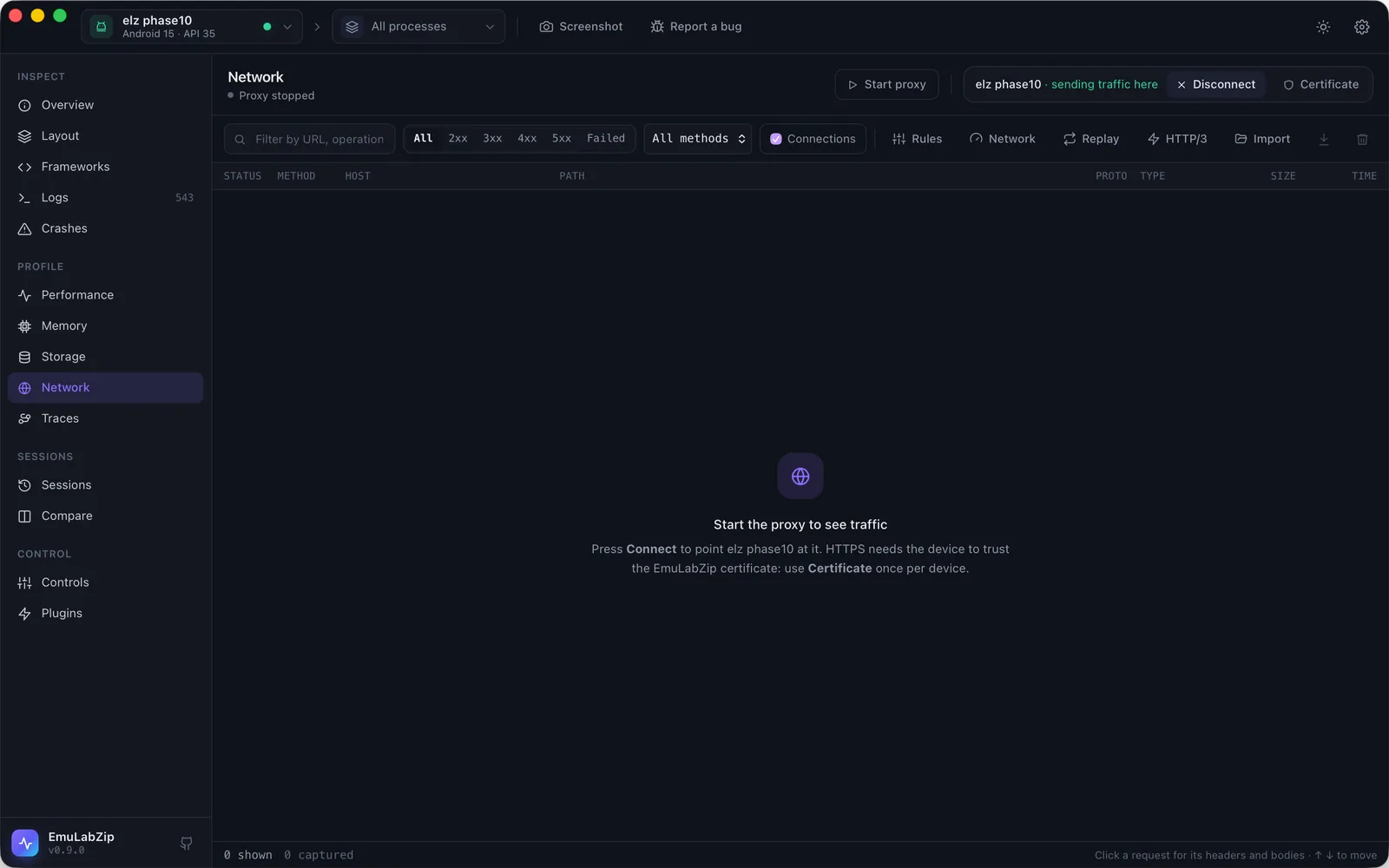
A replay answers the app's requests from a recording, so the servers are never asked. The app runs without the internet, against what a server said once. It is for bugs whose backend has changed since, and for runs in CI that must give the same result every time.
# Record once, with the network.
emulabzip session record -o run.ezsession --app com.example.app --network

# Run the app against it. Press Ctrl+C to stop.
emulabzip net --replay run.ezsession
A session with its network, or any HAR file (a browser's export, or emulabzip net --har), is a recording.
What it does#
The proxy checks the recording before it asks a server. A request that is in it gets the recorded answer: the status,
the headers and the body, as they were. A request that is not in it fails with a 504 that says not in recording,
and shows in the request list marked as failed. It is never sent to the server. That is the point: a test that depends
on an address nobody told you about fails, instead of quietly using the network.
- Requests are matched on the method, the host, the path and the query. The order of the query parameters does not matter; the port does not either.
- A request recorded more than once gets the answers in the order they were recorded, and the last one again after that. A counter that said 1, then 2, says 1, then 2, then 2.
- When requests to the same address differ in their body (a GraphQL query, say), the one with the same body is preferred.
- HTTPS works, because the proxy ends the TLS itself (the device has to trust the certificate as for any capture).
- A rule from Mocks still wins over the recording, because you wrote it on purpose.
What it does not do#
While a recording is replayed, what cannot be answered from a HAR file is refused instead of being let through to the internet:
- WebSockets. Their messages are in the file, but not replayed.
- gRPC calls. A HAR file has no trailers, so the call could not finish.
- Connections the proxy cannot decode: other protocols, and apps that do not accept the EmuLabZip certificate.
- Sending a request again from the Network view.
Requests that failed when they were recorded are not in the recording.
Letting some through#
emulabzip net --replay run.ezsession --passthroughWith --passthrough, a request that is not in the recording goes to the real server. Use it when you only want to freeze
part of what the app does. --timing makes each answer wait as long as the server did, for an app that behaves
differently when the network is slow.
In CI#
emulabzip ci -o run.ezsession --network --replay baseline.ezsession --fail-on-miss -- ./gradlew connectedCheckThe run records itself as usual, with its requests answered from baseline.ezsession. --fail-on-miss fails it when the
app asked for something that is not in the recording, and the end of the run lists what. session record takes
--replay too. Both need --network.
In the app#
In Network, Replay → Choose a file… loads a HAR file or a session. A bar shows what is being replayed, how many requests were answered and how many were not (and which, under Not recorded). In Sessions, Replay network loads the open session. Start the proxy and connect the device as usual; Stop replay goes back to the servers.
Good to know#
- The recording is read before anything else, so a wrong file or a session without a network is explained at once.
- The answers are the recorded bodies, decoded.
Content-Encoding,Content-LengthandAlt-Svcare not repeated, so the app is not told to use a compression the body no longer has, nor to try HTTP/3 around the proxy. - A recording holds what the server sent, including tokens and personal data. Look before you share it.