
Readable stacks
A release build hides its names. R8 and ProGuard rename classes to a.b.c, React Native ships one JavaScript bundle
where every position is 1:608617, and an iOS app without symbols has bare addresses. EmuLabZip reads them back into
what you wrote, when it has the file the build made for that purpose.
| What crashed | The file | What you get |
|---|---|---|
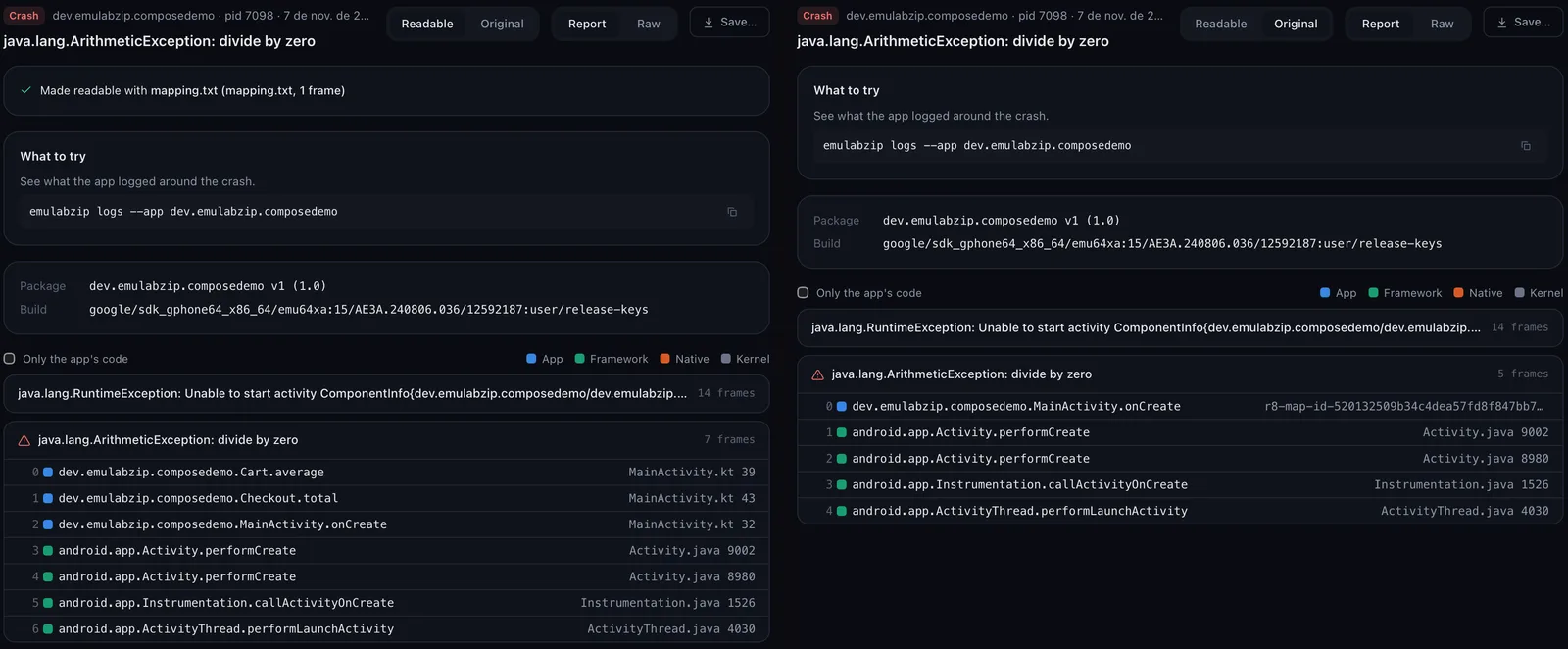
| Java or Kotlin, minified with R8 or ProGuard | mapping.txt | Cart.average in MainActivity.kt:39, with inlined calls given back as frames of their own |
| React Native JavaScript (Hermes or JavaScriptCore) | the source map of the bundle | App.tsx 17:14 instead of 1:608617 |
| An iOS app | its .dSYM | function, file and line for each address (on a Mac, with atos) |
Quick start#
Keep the file for the app and the version it belongs to, once. Every crash of that build is read with it from then on.
emulabzip mappings add com.example.shop "1.2.0 (42)" app/build/outputs/mapping/release/mapping.txt
emulabzip crash dropbox:data_app_crash:20261023205928        # readable
emulabzip crash dropbox:data_app_crash:20261023205928 --raw  # as the device wrote it
In the desktop app, open Crashes. A crash that could be read better says what is missing and offers Add mapping or source map… and Add dSYM…: pick the file and the crash is read again. Readable and Original switch between the two.
The version has to match#
A mapping is only right for the build that made it, and reads another build worse than not at all. So files are kept per app and version, and a crash is only read with the ones for its own version. The version is the one the crash shows:
- Android:
1.2.0 (42), the version name and the version code, from thePackage:line of the report. - iOS:
1.2.0 (42), the short version and the build number.
When no file fits, the crash says so and names the version it needs.
Where the files are#
You can keep them anywhere and name them on the command line, one crash at a time:
emulabzip crash <id> --mapping app/build/outputs/mapping/release/mapping.txtor keep them for good with mappings add. They are copied into EmuLabZip's data folder
(~/Library/Application Support/EmuLabZip/mappings/<app>/<version>/ on macOS), so a clean build does not take them
away. emulabzip mappings list shows what is kept, and emulabzip mappings remove <app> <version> forgets a version.
What a file is gets worked out from the file itself, so there is no kind to give; --kind mapping|sourcemap|dsym
says it when it cannot be told.
Android: mapping.txt#
R8 writes it to app/build/outputs/mapping/<variant>/mapping.txt when isMinifyEnabled is on. Keep it for every
release you ship: it is the only way back from the names in a crash.
- Frames are given back with class, method, file and line.
- When R8 inlined a method into its caller, the one scrambled frame becomes the whole chain, inner call first, as it would have been without R8.
- The class names in the title of the exception are restored too.
- Keep
-keepattributes SourceFile,LineNumberTablein your rules, or there are no lines to give back.
React Native: source maps#
The JavaScript of a React Native crash comes in the report as an exception text, not as frames. EmuLabZip reads it into a JavaScript thread with the Java and native threads after it. The positions are looked up in the source map of the bundle:
- Hermes release builds write a composed map,
android/app/build/generated/sourcemaps/react/release/index.android.bundle.map. Use that one; thepackagerandcompilermaps next to it are the two halves it is made of. - JavaScriptCore and Metro bundles use the map
react-native bundle --sourcemap-outputwrites.
iOS: dSYM#
Xcode writes a .dSYM next to every archive. EmuLabZip checks that its UUID is the one of the image that crashed, then
asks atos for every address of that image at once. This needs a Mac, because atos is part of Xcode's tools; on
Linux and Windows a crash with bare addresses says so, and a crash that already has names is shown as it is. The
Simulator often symbolicates the crash report itself when it can find the dSYM, and then there is nothing left to do.
A stack from somewhere else#
A stack you copied from a log, a bug report or a CI run can be read the same way:
emulabzip symbolicate stack.txt --mapping mapping.txt
adb logcat -d | emulabzip symbolicate - --mapping mapping.txt
Java frames are read with a mapping.txt and JavaScript frames with a source map. A .dSYM needs the addresses and
the image of a crash report, which a pasted stack does not have.
For assistants#
get_crash reads the crash with what is kept for its app and version, and says which files it used and what is missing
(symbolication). original: true keeps the names as the device wrote them. See MCP.