
Network rules: files, other servers and contracts
Mocks and breakpoints answer, delay, block or hold a request. Four more actions work on the way a request is answered, and rules can be chained.
| Action | What happens |
|---|---|
File (mapLocal) | Answers with a file on this computer, or with the file of a folder that the path names. The server is not asked. |
Server (mapRemote) | Sends the request to another server, as if the app had asked for it. |
Contract (validate) | Checks the response against an OpenAPI file and shows what does not match. It changes nothing. |
Script (script) | Runs a WebAssembly script on the request and the response. |
In the app these are in Network → Rules, with file pickers. On the command line they go in the same --rules file.
Map local#
{ "name": "bundled assets", "matcher": { "host": "cdn.example.com", "path": "/assets/*" },
  "action": { "type": "mapLocal", "path": "/Users/me/app/dist" } }
With a folder, the part of the path before the rule's own pattern is left off: with /assets/*, a request for
/assets/app.js gets app.js from the folder, and a request for a folder gets its index.html. With a file, the file is the
answer to every request the rule matches. The content type comes from the extension (or from contentType), and status
(200 by default) is the status of the answer. Nothing outside the folder is ever served: .., an encoded %2e%2e, a
drive or a symbolic link that leads out are refused. A file can be up to 50 MB.
The flow shows MOCK and the file that was served.
Map remote#
{ "name": "use my laptop", "matcher": { "host": "api.example.com", "path": "/api/*" },
  "action": { "type": "mapRemote", "scheme": "http", "host": "localhost", "port": 3000, "pathPrefix": "/v2/" } }
What the rule leaves out stays as the app asked, so a host and a port alone send the same path to a local server. pathPrefix
replaces the part of the path before the pattern's first *: /api/users becomes /v2/users. A new scheme or host takes the
scheme's usual port unless one is given. The new server is told its own host, unless "preserveHost": true. The Network view
keeps showing what the app asked and says where the request was sent. Map remote does not apply to gRPC calls.
Contract#
{ "name": "the API contract", "matcher": { "host": "api.example.com" },
  "action": { "type": "validate", "spec": "/Users/me/app/openapi.yaml" }, "thenContinue": true }
Each response is checked, after it has been sent, against an OpenAPI 3.0 or 3.1 description in JSON or YAML (the file is
read when the rule is saved, so a file that cannot be used is refused at once). The operation comes from the method and the
path (/users/{id}, with the servers' base paths), the schema from the status (200, then 2XX, then default) and the
content type, and the body is validated. The flow gets a Contract tab and a badge in the list:
- the response matches (
ok); - it does not match: each problem comes with a JSON pointer into the body (
/items/0/name) and a message, and a status or content type the spec does not describe is one too; - the spec does not describe the request (
unknown), or has no schema to check this response against, or the body is not JSON (unchecked).
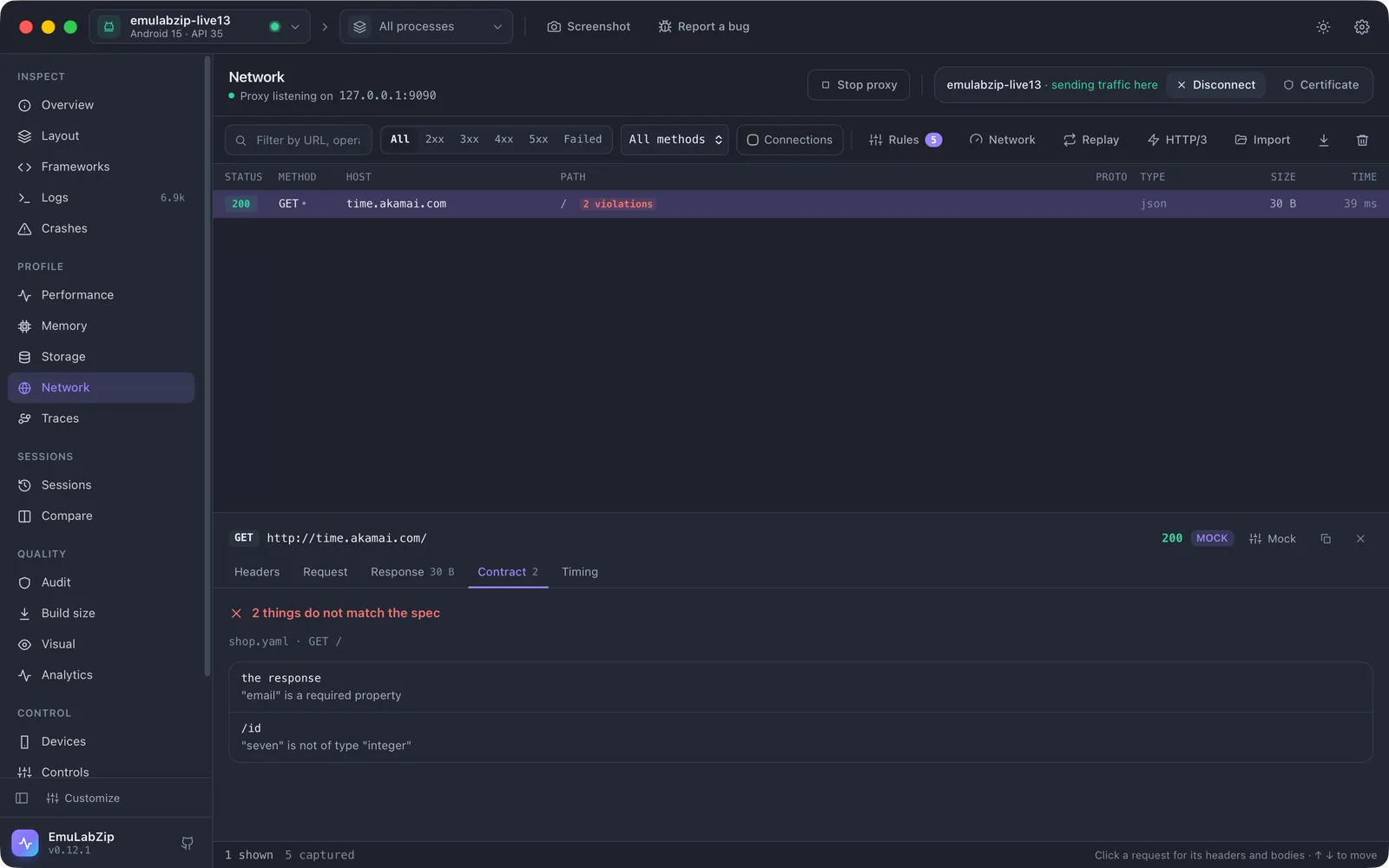
Offline, emulabzip openapi check --spec api.yaml --har run.har checks the responses of a HAR file and exits with an error
when one does not match, which is what a CI step wants. Only responses are checked (not requests), only JSON bodies, and
only $refs inside the file. A Swagger 2.0 file is refused with a message to convert it.
Chaining rules#
The first rule that matches decides, unless it says "thenContinue": true. A rule that changes the request (a delay, a map
to another server, a contract check, a script) can pass the request on to the rules below it; a rule that answers, blocks or
holds the request (an answer, a file, a block, a breakpoint) always ends the search. So a delay followed by a file answers
slowly from the file, and a contract check followed by a mock checks the mock. The flow lists every rule that applied.