
Rule scripts
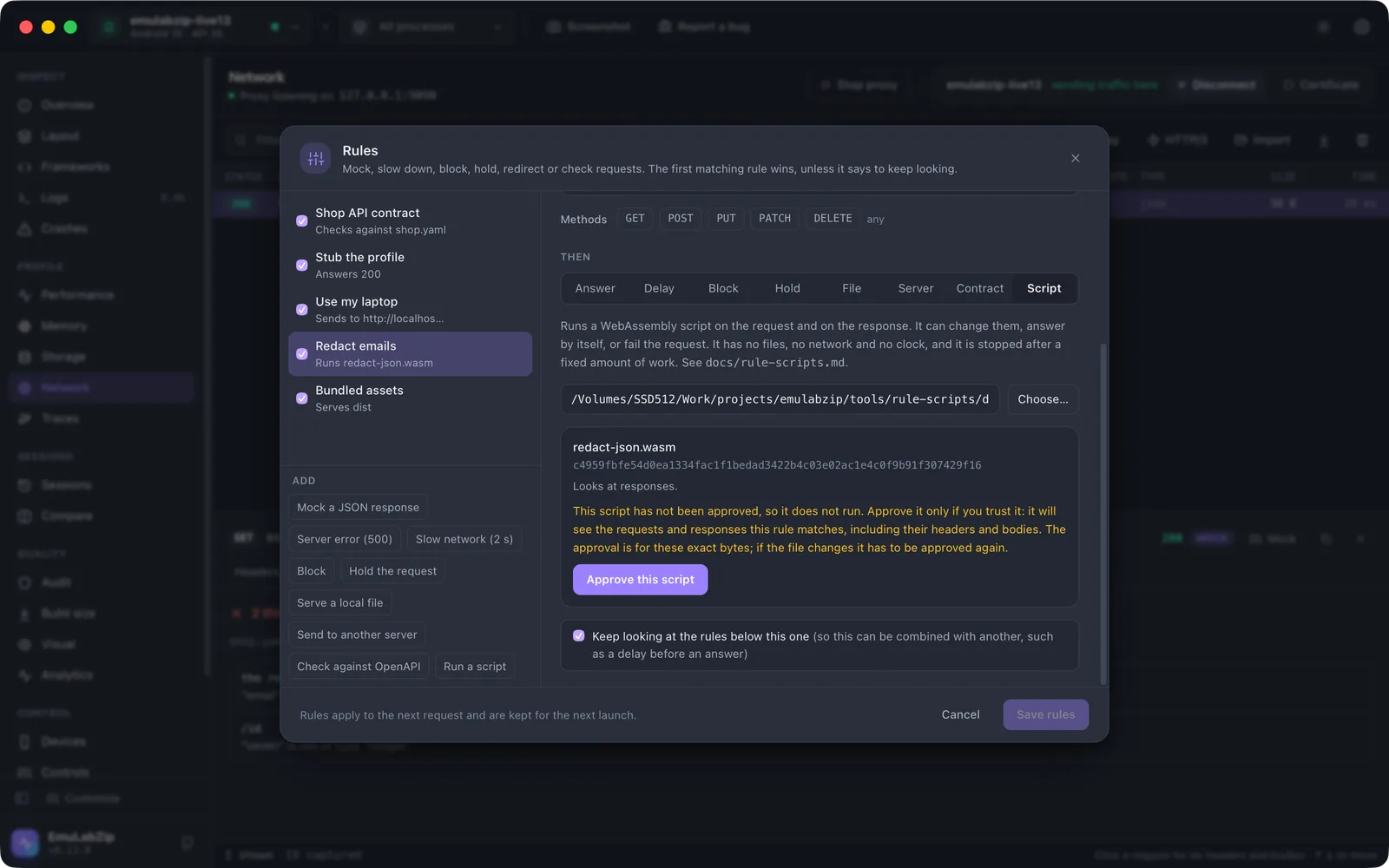
A script is a small WebAssembly program that looks at a request or a response and decides what happens to it: add a header, hide a field, answer on its own, fail one request in three. A rule with the action Script runs it for every request the rule matches.
A script is sandboxed. It cannot read files, reach the network, read the clock or touch anything else on your computer:
the only function it can import is env.log. It is stopped after a fixed amount of work and a fixed amount of memory. And it
runs only after you approved its exact bytes.
Approving#
A script file does nothing until it is approved, in the rule's dialog (Approve this script, which shows its SHA-256 and what it looks at) or on the command line:
emulabzip script show add-header.wasm       # what it does, and whether it is approved
emulabzip script approve add-header.wasm
emulabzip script list
emulabzip script revoke 09e74ff6            # a file, or the start of its hash
The approval is for the file's SHA-256: change one byte and it has to be approved again. Approve only scripts you trust: a script sees the requests and responses its rule matches, with their headers and bodies. A flow whose script did not run says why in its details.
The interface#
A script is a module that exports:
| Export | Type | |
|---|---|---|
memory | memory | The script's linear memory. |
alloc | (len: i32) -> i32 | A pointer to len bytes the host may write into. |
on_request | (ptr: i32, len: i32) -> i64 | Called with a request. Optional. |
on_response | (ptr: i32, len: i32) -> i64 | Called with a response. Optional. |
At least one of on_request and on_response is needed. The host writes a JSON document at ptr (len bytes) and the
function returns (out_ptr << 32) | out_len, where its answer, also JSON, is.
Input
{ "method": "GET", "url": "https://api.example.com/users?id=1",
  "headers": [["accept", "application/json"]],
  "body": "<base64>", "bodyOmitted": false,
  "status": 200 }
status is only there for a response. A response body is decoded (gzip, brotli, zstd). A body of more than 1 MB is not
handed over: bodyOmitted is true and body is empty.
Answer
{ "action": "continue", "status": 201, "headers": [["x-by", "me"]], "body": "<base64>", "text": "…", "message": "…" }"continue"(or noaction) lets the request go on or the response through.headers,body(base64) ortext, and for a responsestatus, replace what was there; what is left out is not changed. A header list replaces the whole list, so start from the input's."replace"(for a request) answers at once with thatstatus(200 by default),headersand body, and the server is never asked. For a response it is the same ascontinue."block"fails the request with a gateway error, sayingmessage.
A script that traps, runs out of work, answers something that is not valid, or asks for something it is not given does not break the request: it goes through as if the script were not there, and the reason is in the flow's details.
Limits#
- Work: 10 million units of fuel for each call, roughly the same number of instructions.
- Memory: 64 MB. A module can be 2 MB, and an answer 8 MB. At most 20 lines of
env.log, 1 KB each. - A new instance for every call, so nothing a script keeps survives to the next request; use the URL when a choice has to be repeatable.
- No imports other than
env.log(ptr: i32, len: i32), which writes a line that shows in the flow.
Writing one#
Any language that compiles to WebAssembly works. tools/rule-scripts has three examples in Rust, each built for
wasm32-unknown-unknown, with a small helper crate that does the packing:
| Script | What it does |
|---|---|
add-header.wasm | Adds x-emulabzip-script to every request and response. |
redact-json.wasm | Replaces the value of email, token, password and authorization in JSON responses with ***. |
flaky.wasm | Answers 503 for about a third of the addresses, chosen from the URL so the same one always fails. |
cd tools/rule-scripts && ./build.sh # needs: rustup target add wasm32-unknown-unknownThe files in dist/ are built already. Add the script to a rule, approve it, and watch the flow.